When AI enters every job, the safety net can't remain optional

A transformation that doesn’t care what sector you’re in
Over the past few months, economic headlines have swung between layoff announcements explicitly blamed on the adoption of artificial intelligence systems and equally striking reversals, with companies forced to rehire staff after running into the real limits of automation. What’s emerging isn’t a single sector in crisis, but a cross-cutting transformation touching production, customer service, back-office functions and even technical roles considered immune until recently.
It’s not just a feeling. The International AI Safety Report 2026, the international report coordinated by a broad group of researchers and government experts, estimates that roughly 60% of jobs in advanced economies and 40% in emerging ones are today exposed to some degree to general-purpose AI systems. The report stresses, however, that the real impact will depend on how quickly companies and workers adopt these tools and how institutions respond: technical exposure, in other words, is not yet economic destiny.
The first signs, for that matter, are already visible in the numbers. In the United States, according to data collected by the Yale Budget Lab and picked up by several economic outlets, the tech and finance sectors are losing on average about 28,000 jobs a month in 2026, an anomaly that stands out in an otherwise solid labor market. In the United Kingdom, a Morgan Stanley analysis calculated that AI-related job losses are running at twice the global average pace, with British companies having cut around 8% of roles over the past year; among the five major economies covered by the study, the US was the only country with a net positive employment balance linked to AI.
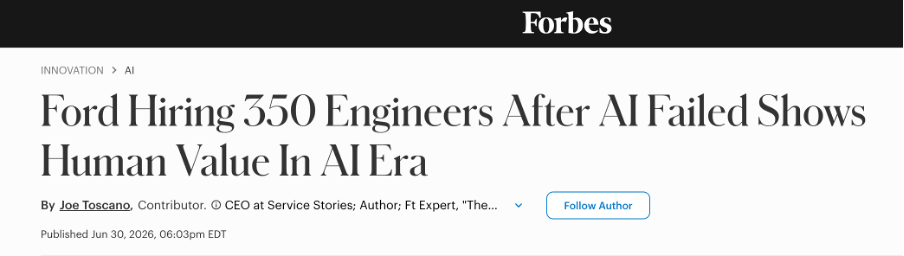
A telling line comes from Charles Poon, Ford’s vice president of hardware engineering.
“AI is a fantastic tool, but it’s only as good as the information you use to train it.”
Incidentally: the automaker is rehiring hundreds of experienced engineers to work on quality problems that automated systems aren’t able to solve — a detail that says more than plenty of analysis.
Cases like this aren’t in short supply, and they’re not just about layoffs that didn’t happen. IBM has handed over most of its own HR functions to artificial intelligence, with the system able to autonomously process around 94% of standard requests. The remaining 6%, though, proved out of reach: cases requiring complex ethical judgment. Faced with that limit, IBM later announced a goal of tripling junior hiring across all its US divisions by 2026.
Not to mention the compromise of roughly 20,000 Instagram accounts, including those of the White House and Obama, or the Air Canada debacle, in which the airline was forced to refund a customer after an incorrect response from its own chatbot: all cases tied to the use of AI agents.
Maybe Tufekci — the Turkish-American sociologist and writer, a professor of Sociology and Public Affairs at Princeton and a New York Times columnist — got it right? In one of her New York Times pieces she argues that large language models shouldn’t be mistaken for reasoning machines: in her words, they’re “plausibility engines,” systems that generate answers based on the statistically likely connections in the data they were trained on, not on truth or reasoning. That’s why, she writes, she doesn’t buy predictions of an imminent AI-driven jobs apocalypse: the tasks that are easy to automate were already eliminated long ago thanks to traditional computing, while what’s left of human work requires common sense and judgment that today’s chatbots don’t possess. That, however, doesn’t stop generative AI from destabilizing society in ways deeper than we can easily imagine.
When AI’s own leading players are the ones asking for rules
What’s striking is that the alarm isn’t coming only from unions or critical observers, but also from those who build and finance artificial intelligence. At the World Economic Forum in Davos, JPMorgan CEO Jamie Dimon warned that governments and businesses will need to step in to support workers displaced by automation, or risk serious social tension.
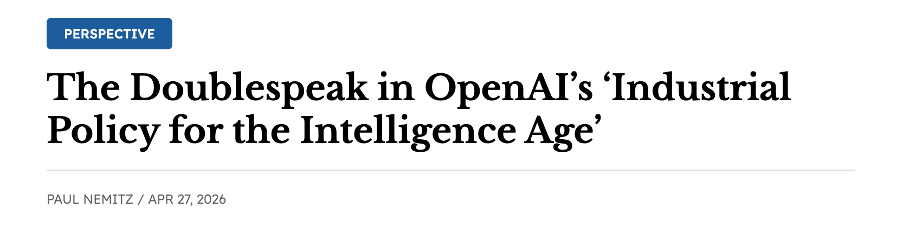
OpenAI too, in a policy document released in April 2026 titled Industrial Policy for the Intelligence Age, argued for an ambitious industrial policy and a new social contract capable of redistributing the productivity gains generated by AI while limiting the risk of large-scale job displacement. Among the most discussed proposals: a public fund financed by industry companies to give every citizen a share of the value the technology generates, an “efficiency dividend” in the form of a shorter work week at the same pay, and higher capital taxation to fund stronger safety nets.
Along similar lines, according to Axios, some analysts and former public officials are working on fiscal-architecture proposals to have ready before any large-scale employment shock materializes, rather than scrambling to react once a crisis has already started: ideas on the table include job-portable subsidies and differentiated taxation penalizing companies able to generate large output with ever-shrinking headcounts.
The first institutional responses, across the US, Europe and Italy
Some governments have already started moving. In California, Governor Gavin Newsom signed an executive order in May 2026 requiring state agencies to build a structured response framework for AI-related job disruption, reviewing existing protections — from severance pay to other forms of compensation — and strengthening access to unemployment benefits. Several bills have been introduced in the US Congress, such as the AI Workforce PREPARE Act, aimed at shifting the focus from job losses alone to managing the broader transition, though progress remains slow in an election year.
In Europe the regulatory framework is more developed: the EU’s AI Regulation (AI Act) enters full application on August 2, 2026. In Italy it was transposed through law 132/2025, while the Ministry of Labour and Social Policies issued guidelines in December 2025 for the responsible adoption of AI in the workplace and launched a national Observatory, in partnership with INAPP, to monitor the sectors and professions most exposed and propose concrete solutions. On the social-safety-net front, the 2026 budget law and related decrees updated the protection system for workers and businesses, though the tools remain designed more for traditional cyclical downturns than for a structural technological transition like the one underway.
Why public intervention can no longer be postponed
Putting all of this together, there’s really one central point: whatever form it takes — assistants supporting staff, agents replacing entire workflows, systems redesigning whole business functions — artificial intelligence is set to touch almost every profession, with none truly fully exempt. It’s no longer a question of “if,” but of speed, intensity and who bears the cost.
That’s precisely why joint action by governments isn’t just desirable, it’s becoming a forced political choice. On one side, we need tools that discourage indiscriminate cuts happening faster than the economy’s real capacity to reabsorb workers — through incentives, transparency requirements on the employment impact of technology choices, and reskilling pathways funded in advance rather than chased after the layoff has already happened. On the other, for those who won’t manage to re-enter the workforce regardless, we need robust, lasting social safety nets — not the bridge subsidies designed for the cyclical crises of the past — combining updated benefits, genuinely accessible continuous training and, per some of the most widely discussed international proposals, forms of redistributing the value generated by automation.
Jevons was a British economist (William Stanley Jevons, at the time), who in 1865, in his book The Coal Question, observed a seemingly counterintuitive phenomenon: improvements in the efficiency of steam engines, which should have reduced coal consumption in Britain, instead increased it. The reason: by making coal cheaper to use, the efficiency gain widened its possible uses, and overall demand grew by more than the savings achieved per unit of work.
The Jevons paradox reminds us that making a process more efficient doesn’t lead to using fewer resources — paradoxically, it tends to increase overall use. It says nothing, though, about who benefits from that surplus: that’s a political question, not a technological one. And that is precisely the decisive question.
The principle has since been applied to many other contexts, from energy and water consumption to computing. In the current debate on AI, the analogy is direct: making artificial intelligence more efficient (cheaper, faster, less energy-hungry models) doesn’t necessarily lead to “using it less,” but tends to widen its use into new areas, increasing overall consumption of compute and energy and, in this line of reasoning, its impact on the labor market too. Hence the closing observation: technical efficiency alone doesn’t decide who wins and who loses from this process; that, precisely, is a political choice.
Letting the market alone decide the timing and casualties of this transition — as even many of the AI industry’s own leading figures now warn — risks dumping the cost of a collective technological choice onto individuals. Coordinating responses across governments, so that no single country tackles the issue on its own and risks a race to the bottom on worker protections just to stay competitive: that is the real political stake of the AI era, perhaps more decisive than the technological race itself.
Fenix & Vega, naturally, isn’t just watching from the sidelines: with maximum flexibility and a constant eye on the shifting landscape described above, we always work to find the compromise best suited to our clients’ business needs — call it strategy, or, in the short term, tactics.
We don’t get swept up by novelty, by the rush of the latest development in computer science, and we don’t chase the latest trends impulsively. Our focus on continuous training and on studying each topic from multiple angles lets us “ride the waves” of AI while preserving, as our primary objective, our partners’ and clients’ investments.
Sources: International AI Safety Report 2026; LSE United States Politics and Policy Blog; Yale Budget Lab (data as covered by Insurance Journal, July 2026); Morgan Stanley / Baker Tilly Global Insights; Axios; OpenAI policy document “Industrial Policy for the Intelligence Age” (April 2026); Governor of California, executive order May 2026; Ministry of Labour and Social Policies; iusprivacy.eu; redigo.info.